On an island shaped by distance, weather, and deep ties to land, creative community has always mattered in Tasmania.
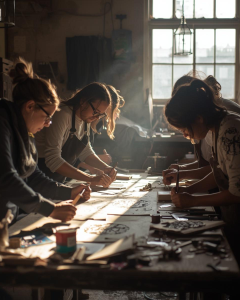
From small-town halls to backyard studios, from kitchen tables to coastal workshops, making here has long been a shared language – one that connects people across generations, disciplines, and places. There is a quiet power that emerges when people gather around shared acts of making.
Creative communities – whether they form in studios, sheds, kitchen tables, online spaces, or community halls – are not just about producing art or craft. They are about belonging. About being seen. About learning how to create together rather than alone. In a world that increasingly values speed, productivity, and individual achievement, creative communities offer something radically different: slowness, care, and connection.
Creativity Is Not Meant to Be Isolated
The myth of the solitary artist is a persistent one. While time alone is often essential to creative work, very few creative practices truly thrive in isolation.
Historically, making has always been communal. Skills were passed down through families, guilds, workshops, and cultural traditions. Stories, techniques, and materials were shared, refined through conversation and observation.
Creative communities keep this lineage alive. They remind us that creativity is not a competition, but a conversation. When we witness how others work – their processes, mistakes, experiments, and breakthroughs — we learn permission. Permission to try, to fail, to begin again.
Belonging Fuels Creative Confidence
One of the most powerful roles creative communities play is offering a sense of belonging.
For many makers, especially those early in their journey, self-doubt can be louder than inspiration. Being part of a creative community softens that inner critic. It replaces comparison with encouragement and fear with curiosity.
Hearing someone say “I struggle with that too” or “Your way of doing this is interesting” can be transformative. Creative confidence doesn’t grow in a vacuum. It grows through shared experiences, gentle feedback, and mutual respect.
Shared Making Strengthens Well-being
Creative communities are not just artistically nourishing – they are emotionally sustaining.
Research consistently shows that creative practice supports mental health, reduces stress, and builds resilience. When creativity is shared, those benefits multiply.
Gathering to make creates spaces where conversation flows more easily. Hands busy, hearts open. Stories emerge naturally. Silences feel comfortable.
In these spaces, people are allowed to show up as they are – tired, hopeful, uncertain, inspired. Making together becomes a form of care.
Local Creative Communities Shape Place
Creative communities are deeply connected to place. They reflect local materials, landscapes, histories, and values. In Tasmania especially, creative work is often shaped by seasonality, weather, resourcefulness, and a strong sense of environment.
When we support local creative communities, we are also supporting:
- Cultural continuity
- Sustainable practices
- Local economies
- Intergenerational knowledge sharing
Creative communities help tell the stories of where we live — not through headlines, but through hands and heart.
Community Over Perfection
Perhaps the most radical thing creative communities offer is a shift away from perfection.
In community spaces, work-in-progress is welcomed. Questions are encouraged. Experiments are celebrated. This openness allows creativity to stay alive and playful. It keeps making human.
Creative communities remind us that the value of making is not only in the finished piece, but in the relationships built along the way.
Why Creative Communities Matter, Now More Than Ever
In uncertain times, creative communities become anchors. They offer continuity when things feel fragmented. They provide meaning when systems feel overwhelming. They give people a place to contribute, to connect, and to create beauty, even quietly, in their own way.
Creative communities matter because they help us remember who we are when we are making, together.
🌿 Maker Reflection
Take a moment to reflect in your journal or sketchbook:
- Where do you experience creative community – and where might you be longing for it?
- How does your creativity change when it is shared rather than hidden?
- What small step could you take to deepen your connection to a creative community this season?
You don’t need a formal group to belong. Sometimes community begins with one shared table, one conversation, or one invitation to make together.
At Tasmanian Maker’s Journal, we believe creativity flourishes in connection – especially here, where place and people are so deeply entwined. If you’re part of a Tasmanian creative community – or dreaming of building one – we’d love to hear your story. Together, we continue the long tradition of making, sharing, and belonging on this island.
Caroline
Editor & Maker, Tasmanian Maker’s Journal
Pingback: Twenty Years of Truly Tasmanian - Tasmanian Maker's Journal