When the forest floor becomes your supply shop and every walk a gathering ritual
There is a particular kind of joy that comes from picking something up off the ground — a feather, a river stone, a curl of bark — and seeing it not as debris, but as material. Raw, beautiful, entirely free, and already shaped by forces more patient than any human hand.
Foraged art is one of Tasmania’s most quietly practised creative traditions. Walkers carry seed pods home in coat pockets. Gardeners press the year’s flowers between book pages without quite knowing why. Children return from the beach with fistfuls of shell and sea glass, instinctively knowing that these things are worth keeping. This is the beginning of a making practice and it doesn’t need a studio, a budget, or a course to begin.
The bush doesn’t sort its textures for you. That randomness — the way a gum leaf sits next to a quartz pebble next to a fragment of lichen — is the whole lesson in composition.
Why forage? The case for nature as a creative supply
Foraged materials bring something into creative work that manufactured supplies rarely can: evidence of a life lived. A piece of dried banksia has been rained on, bleached by sun, and carried by wind. A piece of driftwood has been shaped by water over years. When you work with these things, that history enters the piece.
For makers who care about sustainability — and in Tasmania, so many do — foraging offers an honest alternative to consuming new materials. It connects creative practice to place, to season, and to the specific character of the landscape you actually live in. A maker in the Huon Valley works with different textures than a maker in the Northeast. That difference is the point.
A note on ethical foraging
Always forage what has already fallen — leaves, feathers, bark, and seed pods from the ground rather than living plants. On public land, check local guidelines. Never remove material from National Parks or reserved areas. Take only what you’ll use, and leave plenty for the forest floor’s own ecology. The best foragers are the lightest-footed ones.
What to look for: a Tasmanian forager’s guide
You don’t need to travel far. Start with what’s underfoot in your own suburb, paddock, or park. Over time you’ll develop an eye, and a vocabulary, for material.
Botanical finds
- Gum leaves — pressed and dried, they hold their colour beautifully. Eucalyptus varieties offer everything from silver-green to deep olive.
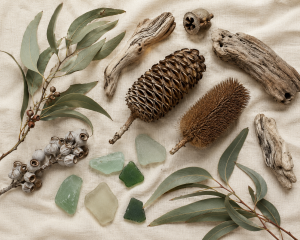
- Seed pods and cones — banksias, she-oaks, and leatherwood all produce pods with strong sculptural form. Excellent for wreaths, relief work, and three-dimensional compositions.
- Bark and lichen — paperbark peels in layers that make beautiful collage material. Lichen-covered bark brings colour and texture unlike anything from a craft supply store.
- Dried grasses and reeds — coastal tussock grass and highland sedge dry into warm, whisky-coloured bundles. Perfect for weaving, binding, and botanical print work.
- Fungi and moss — use carefully and sparingly for artwork intended for display rather than long-term preservation. Dried shelf fungi make extraordinary natural canvases.
Mineral and water finds
- River stones — smooth, flat stones from creeks and riverbeds are natural canvases for painting, carving, or ink work. The weight and coolness of stone brings a grounding quality to any piece.
- Sea glass and shell — Tasmania’s coastline offers extraordinary sea glass, polished by the Southern Ocean. Shell fragments work beautifully in mosaic, resin, and mixed media.
- Driftwood — perhaps the most versatile of all foraged materials. Its sculptural quality can carry a piece almost entirely on its own.
- Feathers — fallen feathers (always check species regulations) bring lightness and movement to any composition.
Four ways to start making
If you’re new to foraged art, these four entry points require nothing beyond what you can gather and what you likely already have at home.
1. Botanical pressing and pressing prints
Press fresh leaves, flowers, and grasses between pages of a heavy book for two to three weeks. Once dried, arrange them directly on card or paper and seal with a thin layer of PVA glue or matte medium. This is ancient in its simplicity and endlessly varied in its results. No two arrangements are alike — the material decides as much as the maker.
2. Natural ink and dye making
Tasmania’s plants offer a remarkable palette to those willing to experiment. Blackberries, wattle seed, walnut shells, and iron-rich clay all yield rich, unpredictable colour. Boil collected material, strain, and test on natural fabric or watercolour paper. The results are never quite the same twice — which is exactly the point.
3. Stone and driftwood painting
Smooth river stones and flat pieces of driftwood are some of the most forgiving surfaces a maker can work on. Use acrylic or watercolour paints, natural pigments, or simply work with pen and ink to add botanical illustrations, abstract patterns, or small scenes. These make wonderful gifts and require almost no setup.
4. Sculptural assemblage
Assemblage — the art of combining found objects into a cohesive composition — is where foraged materials truly come into their own. Arrange seed pods, bark, stone, feather, and bone onto a piece of driftwood or heavy board. Use wire, twine, or natural adhesive to fix elements in place. There are no rules beyond asking: does this feel true to the place it came from?
The materials don’t lie. Whatever you bring back from a walk — the colours, the textures, the weight of things — that’s the story the land is telling. Your job is just to listen and arrange.
Foraging through the seasons
One of the deep pleasures of nature-based making is that your material palette shifts through the year. No season gives you everything — and that constraint is a gift.
| Autumn Peak time for seed pods, fallen leaves in full colour, and fungi. The richest foraging season in Tasmania. | Winter Bare branches, lichen, bleached grasses, and driftwood after storms. | Spring Fresh greens to press, wattle blooms for dye work, and the first coastal flowers of the year. | Summer Sea glass and shells from beach walks, dried grasses, sun-bleached bark, and coastal botanicals. |
Building a forager’s studio (it’s simpler than you think)
You need very little. A few glass jars for storing small finds. A flower press or stack of heavy books. A shallow tray for sorting and arranging. Good scissors and some PVA glue. Over time you’ll build a collection of materials that feel like a personal archive of every walk you’ve taken.
The practice teaches patience — you can’t rush a pressed flower or a piece of driftwood you haven’t found yet. It teaches attention — you start to notice things you walked past for years. And it teaches contentment with imperfection, because natural materials do exactly what they like.
🌿 🪨 🍂 🐚 🌾
Every walk is a studio visit. Every pocket full of found things is a brief.
A few final thoughts
Foraged art doesn’t ask you to be an artist. It asks you to be curious, attentive, and willing to let the landscape lead. Tasmania is one of the most materially generous places on earth — forests full of texture, coastlines full of form, seasons that mark time with remarkable clarity.
Start with a walk. Bring a bag. See what asks to come home with you.
Then make something.
Caroline
Editor & Maker, Tasmanian Maker’s Journal