In a world that celebrates speed, productivity, and constant availability, slow craft offers a quiet, radical alternative.
Slow craft is not about nostalgia or resisting progress. It is about intention. It asks us to pay attention – to materials, to process, to our own bodies and rhythms – and to value how something is made as much as the finished object itself.
For makers, artists, and creatives, slow craft can feel like both a refuge and a rebellion.
What Is Slow Craft?
Slow craft is rooted in the same philosophy as the slow food and slow living movements. It prioritises:
- Mindful, hands-on making
- Traditional or skill-based processes
- Quality over quantity
- Connection to place, materials, and story
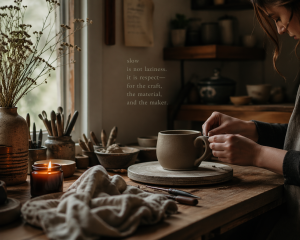
It might look like hand-stitching instead of machine sewing, mixing pigments by hand, carving wood slowly with simple tools, or allowing a project to unfold over days or weeks rather than hours.
Slow craft is not defined by what you make, but how you make it.
Making as an Act of Presence
When we work slowly, we are fully present.
Our hands learn the material. Our breath settles into the rhythm of repetition. We begin to notice small details – the pull of thread, the grain of timber, the resistance of paper beneath a blade. In this way, slow craft becomes a form of quiet meditation.
It invites us out of the constant mental noise of notifications, deadlines, and comparison, and back into the simple dialogue between hand, heart, and material.
Resisting the Pressure to Produce
Social media and online marketplaces have changed the way craft is shared and valued. While these platforms offer visibility and connection, they also create pressure:
- To produce more
- To work faster
- To constantly share finished results
Slow craft gently pushes back against this.
It allows space for unfinished work, for learning curves, for mistakes, and for rest. It reminds us that creative work does not need to be optimised to be meaningful.
Not every piece needs to be photographed.
Not every practice needs to be monetised.
Not every moment of making needs an audience.
The Emotional Value of Handmade
Objects made slowly carry something intangible.
They hold time, care, and attention. They remember the maker’s mood, the season, the place where they were created. This is why handmade objects often feel comforting, grounding, and deeply personal.
In a fast world of mass production and disposability, slow craft restores emotional value to objects. It asks us to keep, mend, and cherish rather than replace.
Slow Craft as Sustainability
Working slowly naturally encourages sustainability.
Makers who take their time tend to:
- Use fewer materials
- Waste less
- Choose quality tools and fibres
- Repair rather than discard
Slow craft aligns us with natural cycles rather than industrial ones – seasons, daylight, energy levels. It honours the limits of both the maker and the materials.
A Tasmanian Perspective on Slow Making
Here in Tasmania, slow craft feels especially at home.
Our landscapes, weather, and distances already invite a gentler pace. Makers across the island draw inspiration from forests, coastlines, and rural rhythms — working in tune with light, season, and solitude. In sheds, studios, kitchens, and community halls, slow craft continues to thrive as a way of staying connected to place and to one another.
Choosing Slow, One Stitch at a Time
Slow craft does not demand perfection, purity, or rigid rules.
It simply asks us to pause.
To listen.
To let making be enough.
In choosing to work slowly – even occasionally – we reclaim creativity as nourishment rather than performance. We allow ourselves to make for the sake of making, and to find beauty not only in the finished piece, but in every step along the way.
In a fast world, slow craft is a quiet form of care.
🌿 Maker Reflection
- When was the last time you allowed yourself to make something without a deadline or outcome in mind?
- What might change in your creative practice if you gave yourself permission to slow down?
Caroline
Editor & Maker, Tasmanian Maker’s Journal